Programming Languages 2026-2031: The AI Era Forecast
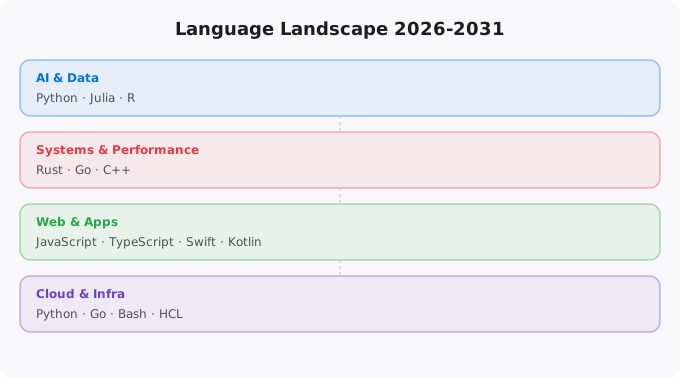
The programming language landscape is evolving faster than at any point since the rise of the web in the mid-1990s. AI tools are changing how developers interact with languages, what properties matter in a language, and which languages are becoming more or less central to the industry. Understanding these trends is valuable for anyone making decisions about what to learn, what to build with, and where to invest skill development effort.
Python: The Indispensable Language
Python entered the 2020s as the language of choice for machine learning, data science, and scientific computing. It is likely to exit the 2020s with that position even more entrenched. The entire AI ecosystem — PyTorch, TensorFlow, LangChain, Hugging Face, and essentially every new AI framework — is built in Python first. The language's readability and the size of its library ecosystem make it uniquely well-suited for the exploratory, iterative work that AI development requires. Python's weaknesses — performance limitations, the GIL (Global Interpreter Lock) that constrains multi-threading, and some dynamic typing pitfalls — have spurred interest in alternatives for performance-critical work. Rust and Go address different aspects of these limitations. But for the AI and data science domains, Python's dominance is unlikely to be seriously challenged by 2031.
JavaScript and TypeScript: The Web's Lingua Franca
JavaScript is inescapable in web development, and TypeScript — which adds static typing to JavaScript — has become increasingly dominant in professional frontend and Node.js development. The React ecosystem continues to mature, Next.js has established itself as a leading full-stack framework, and the tooling around TypeScript continues to improve. AI tools have made JavaScript and TypeScript particularly interesting — the rich type information in TypeScript provides context that AI coding assistants can use effectively, making TypeScript development with AI assistance particularly productive. The JavaScript/TypeScript ecosystem will remain central to web development through 2031. The question is how the ecosystem evolves around AI-powered development, where tools like v0, Cursor, and similar products are already changing how web interfaces are built.
Rust: The Rising Star for Systems Work
Rust has been the most admired language in the StackOverflow developer survey for several consecutive years. It offers memory safety without a garbage collector — delivering the performance of C/C++ with significantly better safety guarantees. Rust is increasingly being used for systems programming, embedded systems, web assembly, cloud infrastructure tooling, and performance-critical components. Microsoft, Google, Meta, and the Linux kernel project have all made significant investments in Rust, and its relevance in performance-critical domains will continue to grow through 2031. For most application development, Rust remains overkill — its learning curve is steep and its strictness, while a feature for systems work, can be excessive overhead for typical web services or data processing applications. But for those working in systems, infrastructure, or performance-critical domains, Rust is worth serious investment.
Go: Cloud Infrastructure's Language
Go (Golang) was designed by Google for building scalable, reliable server-side applications, and it has become the language of choice for cloud infrastructure tooling. Kubernetes, Docker, Terraform, and many other foundational cloud tools are written in Go. The language's simplicity, fast compilation, built-in concurrency primitives, and single-binary deployment make it well-suited for building reliable services. For anyone working in cloud infrastructure, DevOps, or building backend services that need to be reliable and performant without Rust's complexity, Go is an excellent investment. Its relevance will remain strong through 2031 as the cloud-native ecosystem — which is predominantly Go-based — continues to grow.
SQL: The Quiet Constant
SQL is over 50 years old and is not going anywhere. Every data-intensive application needs to interact with relational databases, and SQL is how that interaction happens. The ability to write effective SQL — complex queries, proper indexing, understanding query execution plans, designing normalized data models — is a perennial skill that remains valuable regardless of what other languages or frameworks are trending. The rise of data engineering and analytics engineering (using tools like dbt) has actually increased the importance of SQL in many organizations. If you work with data, SQL proficiency is non-negotiable.
The AI Impact on Language Choice
AI coding tools have changed the calculus of language choice in an interesting way. For experienced developers, AI assistance reduces the friction of working in a less-familiar language — if you know Python well, getting AI help to write a Go service is more feasible than it was without AI assistance. This may gradually reduce the penalty for using less-common languages in heterogeneous technology stacks. However, AI tools are more effective in languages with large training datasets — which means popular languages with abundant documentation and open source code. Python, JavaScript, TypeScript, and Java have the richest AI assistance available. This creates a reinforcing advantage for already-popular languages in the AI era.
What to Learn for 2026-2031
For most people building a technology career in this period: Python is essential if you have any involvement with AI, data, or automation. JavaScript or TypeScript is essential for web development. SQL is essential for anyone working with data. Beyond these foundational languages, specialize based on your domain — Go for cloud infrastructure, Rust for systems work, Java or Kotlin for enterprise backends. Do not let the breadth of options paralyze you. Pick the languages most relevant to the work you want to do and learn them deeply. Shallow knowledge of many languages is worth less than deep knowledge of the two or three that matter most for your domain.
Key takeaways
- The next five years won't have one dominant language. The interesting motion is in tooling, infra, and AI-assisted workflows — not new syntax.
- Python keeps growing because of data + AI + automation. JavaScript stays dominant on the web. Go and Rust eat systems. Java and C# stay enterprise-defaults.
- Languages with great LLM training data have an advantage now. Python, JS, Java, Go — these will benefit more from AI tooling than niche languages.
- If you're picking one language for 2026-2031, pick the one closest to what you want to build, not the one with the trendiest name.
Practice and Building: The Path to Real Skill
Reading about technology and doing technology are fundamentally different activities. You can understand a concept intellectually without being able to apply it under real conditions. The gap between understanding and skill closes through deliberate practice — working on problems that are slightly beyond your current comfort level, where you have to stretch and figure things out. Comfortable practice does not build skill the same way that challenging practice does. Seek out projects and problems that require you to use what you have learned in new contexts, where you cannot just repeat what you have seen before but must think through a new application of familiar principles.
Document your learning publicly. Writing a blog post explaining what you learned, pushing a project to GitHub, or sharing a solution in a community forum creates accountability, consolidates understanding, and builds a visible portfolio. Many opportunities — jobs, collaborations, mentorships — come through the content people create and share. Start writing and building in public early, even when you feel like you do not know enough. The imposter syndrome is universal; do not let it delay the habit of sharing.
This article is for educational and informational purposes only. It does not provide career, financial, or professional advice. Technology trends evolve over time. Always evaluate tools and skills based on official documentation and real-world requirements.
How AI Is Changing Language Choice
AI coding assistants like GitHub Copilot, Cursor, and Claude have changed the economics of learning new programming languages. The friction of working in an unfamiliar language is lower when AI can generate correct boilerplate, suggest idiomatic patterns, and explain error messages. This changes the calculus of language choice -- language ecosystem and tooling matter more than syntax familiarity.
But AI has also reinforced the importance of the dominant languages. Copilot is significantly more capable in Python, JavaScript, TypeScript, and Go than in niche languages -- simply because more training data exists for popular languages. Choosing a well-supported language means better AI assistance throughout your career.
RISING DEMAND:
  Python     +++  AI/ML dominance, DevOps, data engineering
  TypeScript +++  JavaScript ecosystem maturity, type safety
  Rust       ++   Systems programming, WebAssembly, safety-critical
  Go         ++   Cloud infrastructure, microservices, Kubernetes ecosystem

STABLE HIGH DEMAND:
  JavaScript ++   Web frontend (irreplaceable), Node backend
  Java       +    Enterprise, Android, Spring Boot ecosystem
  C#         +    Microsoft ecosystem, Unity game dev, enterprise
  SQL        +++  Data is everywhere, querying it never goes out of style

DECLINING BUT STILL RELEVANT:
  PHP        ~    Legacy web (WordPress), still huge deployment base
  Ruby       -    Declining market share but Rails still has niches
  Perl       --   Legacy systems only

FUTURE WATCH:
  Carbon     ?    Google's C++ successor (still early)
  Mojo       ?    Python-like performance for ML (Modular AI)
  Zig        ?    Systems programming, WebAssembly target
The Language Stack That Will Serve You Best 2026-2031
Based on industry trajectory, the combination with the highest career value for the next 5 years is: Python as your primary language for data, automation, ML, and backend. TypeScript as your secondary for full-stack or frontend capability. SQL as your constant -- never stops being useful. Bash for scripting -- every DevOps engineer needs it. Go or Rust as a long-term investment if you are targeting systems, infrastructure tooling, or performance-critical work.
This stack covers: web development, data engineering, cloud automation, system administration, and with Python as the ML/AI default, it positions you for the continued growth of AI-powered applications. It is not the most exotic combination, but it is the most reliable path to sustained high demand and compensation.
More Questions Answered
Will Python be replaced by a faster language for AI work?
Not in the near term. Python's dominance in ML/AI is as much about ecosystem (PyTorch, TensorFlow, NumPy, scikit-learn) as about the language itself. Mojo (Python-compatible, much faster) is being developed for AI workloads but is years from replacing Python. Julia and C++ are used for performance-critical ML inference but Python remains the primary research and development language.
Is learning Java still worth it in 2026?
Yes, particularly for enterprise backend development, Android, and Spring Boot. Java has a massive legacy codebase and enterprise adoption that will take decades to migrate. Kotlin (JVM-compatible) is growing as a more modern alternative. If targeting enterprise development or Android, Java/Kotlin remains very relevant.
What programming language should a complete beginner start with?
Python, without hesitation. Beginner-friendly syntax, enormous community, comprehensive tutorials, and genuinely used professionally across multiple high-demand fields. Once you can build real things in Python, picking up a second language takes months rather than years.
Frequently Asked Questions
Is this topic relevant for Indian tech professionals?
Yes. India is one of the fastest-growing tech markets globally. These skills are in high demand across startups, MNCs, and product companies in Bangalore, Hyderabad, Pune, and Mumbai.
How do I stay updated on this topic?
Follow official documentation, tech blogs from practitioners, GitHub repositories, and communities like Dev.to, Hashnode, and Reddit. Avoid news that creates urgency without substance.
What resources does SRJahir Tech recommend?
Official documentation first. Then practical tutorials. Then build real projects. SRJahir Tech articles are written from real production experience — bookmark the series that matches your learning goal.
How long does it take to see results after learning?
Consistent daily practice for 3-6 months produces real, usable skills. The key is building projects, not just reading. Every article on SRJahir Tech includes practical examples you can implement today.
Is SRJahir Tech content free?
Yes. All articles on SRJahir Tech are completely free. No paywalls, no subscriptions. Quality technical education should be accessible to everyone, especially aspiring engineers in India.