How AI Changes Software Engineering (Not Just Coding)
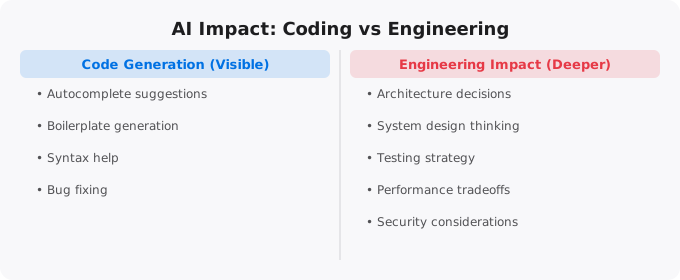
When people talk about AI's impact on software development, they almost always focus on code generation — AI writing code faster, AI autocompleting functions, AI suggesting solutions. This is real and significant. But it misses the deeper and more important transformation: AI is changing software engineering, not just coding. The distinction matters because engineering and coding are different skills with different leverage, and AI affects them differently.
Coding vs Engineering: The Key Distinction
Coding is the act of writing instructions in a programming language. Engineering is the discipline of designing, building, and maintaining systems that reliably solve real problems. Every engineer codes, but not everyone who codes is doing engineering. The difference lies in scope, judgment, and ownership. Engineers think about systems. They consider how components interact, how requirements will change, how the system fails, how it can be understood and modified by others, and how it performs under real-world conditions. Coding is a necessary skill for software engineering, but it is not the entirety of it — and it is the part that AI is most directly affecting.
What AI Is Actually Doing to the Development Workflow
AI coding tools — GitHub Copilot, Cursor, Claude, and similar assistants — are genuinely accelerating code production. Functions that might have taken 30 minutes to write from scratch can be generated in seconds. Boilerplate code that engineers previously found tedious to write can be produced automatically. Simple transformations, data manipulations, and standard patterns can be generated reliably by AI without significant manual effort. This is real productivity improvement. But the nature of the acceleration matters. AI is most effective at generating code that fits established patterns — the kind of code that a reasonably experienced developer could write relatively quickly with some thought. AI is significantly less effective at the genuinely hard parts of software engineering: the ambiguous problems, the novel designs, the debugging of complex system interactions, the architectural decisions with long-term consequences.
The Rise of the Specification Problem
As AI gets better at generating code from specifications, the quality of the specification becomes the limiting factor. If you give AI a precise, well-thought-out description of what you want — including the edge cases, the performance requirements, the error handling, and the integration constraints — it can often produce useful code. If your specification is vague or incomplete, the generated code will be wrong in ways that may be subtle and hard to detect. This means that the engineering skills of requirements analysis, system specification, and architectural thinking become more valuable as AI handles more of the code production. The engineers who can think clearly about what needs to be built — before anyone writes code — are providing higher leverage value than ever before.
Quality Assurance Changes Fundamentally
When code was primarily hand-written, engineers naturally developed intuition for its quality through the process of writing it. You understand code you wrote. AI-generated code creates a different challenge: you have code that may be syntactically correct and even functionally correct in the happy path, but whose edge cases, failure modes, and long-term maintainability you have not thoroughly considered because you did not think through every line. This makes testing and code review skills more important, not less. Engineers working with AI-generated code need strong ability to identify what tests to write, how to think about failure scenarios, and how to evaluate whether generated code is actually correct — not just whether it runs without errors. The shift is from writing code that you inherently understand to evaluating code that someone (or something) else wrote.
The Architecture Layer Remains Human
Software architecture — the decisions about how a system is structured, what components exist, how they communicate, what data models to use, how the system will be deployed and scaled — remains a deeply human domain. These decisions require understanding the specific context of a business, the constraints of a team, the likely evolution of requirements, the trade-offs between competing technical approaches, and the long-term costs of different choices. AI can generate architectural patterns and make suggestions, but the judgment about which patterns are right for a specific context requires the kind of situated understanding that only humans currently possess.
The Human Collaboration Dimension
Software engineering has always been a human activity as much as a technical one. Understanding what users and customers actually need (which is often different from what they say they need), communicating technical trade-offs to non-technical stakeholders, working effectively in teams, managing conflict between technical correctness and business urgency — these are fundamentally human skills that AI does not replace. In fact, as AI accelerates the technical production side of software development, the human collaboration side may become relatively more important. Organizations that can effectively combine technical AI capability with strong human judgment, communication, and collaboration will outperform those that focus only on the technology side.
What to Develop in the AI Era
If you are building a software engineering career in the AI era, prioritize these areas: system thinking and architecture (understanding how to design systems that work reliably at scale), requirements analysis (the ability to translate business needs into precise technical specifications), testing and quality thinking (deeply understanding what makes code correct and how to verify it), code review skills (evaluating code for correctness, maintainability, and security), and communication skills that allow technical concepts to reach non-technical stakeholders effectively. Coding proficiency still matters — you need to be able to evaluate AI output, understand the code you are responsible for, and write code when AI assistance is not appropriate. But coding as a standalone skill is becoming less distinctive and less valuable relative to the engineering judgment that surrounds it.
Key takeaways
- AI changes coding by making syntax cheap. AI doesn't change software engineering — the discipline of designing, building, and operating systems that survive contact with reality.
- The boring work that defines real engineering — requirements, trade-offs, error handling, observability, deployment, post-incident reviews — is exactly where AI is weakest.
- Treat AI as a junior pair-programmer with a great memory and bad judgement. It writes fast; you read carefully.
- Senior engineers will lean even harder on architecture, design reviews, and mentorship. Juniors who only use AI without building real understanding will plateau quickly.
Staying Current in a Fast-Moving Field
Artificial intelligence is evolving faster than almost any other technology domain. The specific tools, models, and capabilities that are current today will look different in a year. This makes staying current a genuine challenge — the half-life of specific technical knowledge is short. The strategies that work: follow the primary sources (research blogs from Anthropic, OpenAI, Google DeepMind, Hugging Face) rather than relying on summaries that may be outdated. Focus on underlying principles that transfer — model architecture concepts, evaluation methods, prompt engineering principles — rather than memorizing specific tool interfaces that will change. Build things with current tools to develop practical intuition, even knowing those specific tools will evolve. The professionals who navigate fast-moving fields best are those who can quickly assess new developments, extract the signal from the noise, and rapidly evaluate what is genuinely significant versus what is marketing.
The Real Impact: Changing What Engineers Spend Time On
The most significant change AI brings to software engineering is not that it can write code -- it is that it shifts where human attention is most valuable. When implementation is easier, design becomes more important. When generating boilerplate is instant, architectural decisions matter more. When first drafts are fast, review and judgment are more critical. AI is changing the composition of software engineering work, not eliminating the need for engineers.
Before AI assistants (typical senior engineer time):
  Requirements analysis and design: 20%
  Writing new code: 35%
  Code review and refactoring: 20%
  Debugging and testing: 15%
  Documentation: 10%

With AI assistants (projected shift):
  Requirements analysis and design: 30% (+50%)
  Writing new code: 20% (-43%) -- AI handles boilerplate
  Code review and refactoring: 25% (+25%) -- more output to review
  Debugging and testing: 15% (stable) -- AI helps but complex bugs still hard
  Documentation: 10% (stable) -- AI helps generate, humans review
Skills That Become More Valuable With AI
Certain engineering skills become more valuable precisely because AI handles other tasks. Systems thinking: understanding how components interact, where failures cascade, and how to design for reliability. AI can help implement a microservice, but deciding when a monolith is actually the better choice requires engineering judgment. Debugging complex systems: AI can suggest solutions for common errors, but tracing a bug through multiple services, databases, and asynchronous processes requires human reasoning about the specific system. Security review: AI-generated code can introduce vulnerabilities -- engineers who understand security can identify AI-generated code that is vulnerable to SQL injection, path traversal, or insecure deserialization. Performance engineering: identifying why a system is slow requires profiling, understanding the execution model, and making architectural changes that go beyond what code generation tools produce.
More Questions Answered
Will AI make junior developer positions disappear?
Not in the near term. Junior developers are valuable for reasons beyond writing code: they learn your codebase deeply, they ask questions that reveal documentation gaps, they grow into mid and senior engineers. AI tools will change what junior developers do -- more code review, more testing, more integration work -- but the role of growing engineering talent remains essential.
How do I stay valuable as a software engineer in an AI world?
Focus on: system design and architecture (designing how components fit together). Understanding business requirements deeply. Security review of AI-generated code. Performance optimisation. Code review judgment. Team collaboration and communication. These skills require deep experience and contextual understanding that AI cannot replicate.
Will AI write 90% of code in 5 years?
AI will likely generate a large fraction of code in the next 5 years -- but "generating code" and "solving software engineering problems" are different things. The challenge of software engineering is rarely writing the code; it is understanding what to build, how to structure it, how to make it reliable, and how to evolve it over time. AI can help with implementation but the engineering judgment layer remains human.
Frequently Asked Questions
Is this topic relevant for Indian tech professionals?
Yes. India is one of the fastest-growing tech markets globally. These skills are in high demand across startups, MNCs, and product companies in Bangalore, Hyderabad, Pune, and Mumbai.
How do I stay updated on this topic?
Follow official documentation, tech blogs from practitioners, GitHub repositories, and communities like Dev.to, Hashnode, and Reddit. Avoid news that creates urgency without substance.
What resources does SRJahir Tech recommend?
Official documentation first. Then practical tutorials. Then build real projects. SRJahir Tech articles are written from real production experience — bookmark the series that matches your learning goal.
How long does it take to see results after learning?
Consistent daily practice for 3-6 months produces real, usable skills. The key is building projects, not just reading. Every article on SRJahir Tech includes practical examples you can implement today.
Is SRJahir Tech content free?
Yes. All articles on SRJahir Tech are completely free. No paywalls, no subscriptions. Quality technical education should be accessible to everyone, especially aspiring engineers in India.