Learn Python: Beginner to Professional
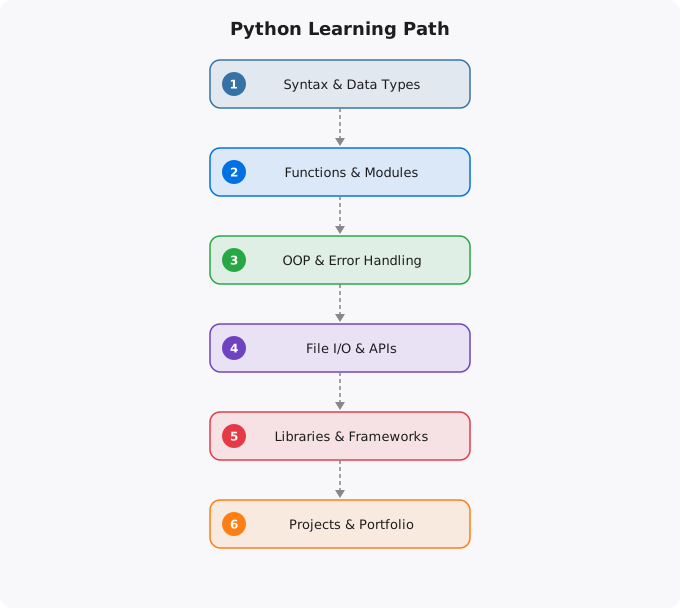
Python is the most important programming language to learn right now. Not because it is the only language, but because it is the entry point to data science, machine learning, automation, cloud scripting, and backend development. Every AI tool, every data pipeline, every modern automation framework has Python at its core. If you want to work in technology in the 2020s and beyond, Python fluency is not optional — it is the foundation everything else builds on.
This guide covers the complete journey from absolute beginner to professional-level Python usage. It is not a list of syntax rules. It is a roadmap for building genuine programming capability, with Python as the vehicle.
Why Python Became the Language of Everything
Python was not supposed to dominate. When Guido van Rossum created it in the late 1980s, C, Java, and Perl were the serious languages. Python was considered a scripting language — useful for small tasks, not serious work. That perception changed gradually, then suddenly. Python's readability meant that scientists and researchers — who needed to program but were not trained programmers — could use it without fighting the language. Libraries like NumPy and SciPy built scientific computing capability. The machine learning explosion brought TensorFlow and PyTorch, both Python-first. Cloud providers built Python SDKs. Django and Flask made Python viable for web development. By the 2010s, Python had become the common language of multiple technical communities that had previously used different tools.
Today, Python is the primary language of data science, machine learning, AI development, cloud automation, scientific computing, and a significant portion of web backend development. It is the language most commonly taught to beginners and the language most commonly used in production AI systems. For a career in technology, Python is the single most important language to learn.
Phase 1: Beginner Foundations (Weeks 1-6)
The beginner phase is about building the mental model that underlies all programming. You are not just learning Python syntax — you are learning to think computationally. Start with variables and data types. Understand that every piece of data in a program has a type — integer, float, string, boolean — and that type determines what operations you can perform on it. Learn why type errors happen and how to read them. Move to control flow: if-elif-else for making decisions, for and while loops for repetition. These two concepts — conditional logic and iteration — are the building blocks of every algorithm you will ever write. Practice them extensively. Write functions. Functions are reusable units of logic with clear inputs and outputs. Learning to write good functions — small, focused, well-named — is the most important early programming skill. If your functions are long and do many things, you are not thinking like a programmer yet.
Handle errors with try-except. Python is explicit about errors, and learning to anticipate and handle them is an early professional habit. Work with lists, dictionaries, tuples, and sets — Python's core data structures. Know when to use each one. A dictionary is not just a fancier list; it is a fundamentally different tool for different problems.
Phase 2: Intermediate — Python for Real Work (Weeks 6-16)
Intermediate Python is where the language becomes practically useful. File handling — reading and writing text files, CSV files, JSON files — is essential for any real automation or data work. API consumption using the requests library: making HTTP requests, parsing JSON responses, handling authentication headers, and dealing with rate limits. This skill connects Python to the entire modern web API ecosystem. Virtual environments with venv or conda: understanding why you need isolated environments for different projects and how to manage dependencies properly. pip and requirements.txt for dependency management. Regular expressions for pattern matching and text processing — a powerful tool that many beginners avoid but professionals use constantly. Working with dates and times, which is more complex than it seems and trips up many developers. Object-oriented programming: classes, instances, inheritance, and when OOP makes your code clearer versus when it adds unnecessary complexity.
Phase 3: Advanced — Systems and Professional Quality (Months 4-8)
Advanced Python is about code quality, maintainability, and performance. Decorators and context managers: Python's powerful patterns for cross-cutting concerns like logging, timing, and resource management. Generators and iterators: lazy evaluation for memory-efficient processing of large datasets. Type hints with mypy: adding static typing to Python for better tooling support and earlier error detection. Testing with pytest: writing unit tests, integration tests, and test fixtures. Test-driven development principles. Profiling and optimization: using cProfile to identify bottlenecks, understanding Python's performance characteristics, and knowing when to use more efficient data structures or move to compiled extensions. Concurrency: threading versus multiprocessing versus asyncio, and which approach is right for which type of work. Project structure: organizing code into packages, understanding imports, building installable packages.
Domain Specializations
Once you have solid Python fundamentals, specialize based on your interests and goals. Data science track: NumPy for numerical computing, pandas for data manipulation, Matplotlib and Seaborn for visualization, Jupyter notebooks for exploration. Machine learning track: scikit-learn for classical ML, PyTorch or TensorFlow for deep learning, Hugging Face transformers for modern NLP. Web development track: Django for full-featured web applications with built-in ORM and admin, Flask for lightweight APIs, FastAPI for modern async REST APIs. Cloud and DevOps track: boto3 for AWS, google-cloud Python client libraries, Paramiko for SSH automation, Ansible for infrastructure automation. Each of these tracks builds on the same Python foundation you build in phases one through three.
How to Learn Python Effectively
The most effective way to learn Python is to build things that you actually want to exist. Not toy programs for their own sake — real utilities that solve problems you actually have. A script that automates something tedious in your daily work. A program that processes data you are already working with. A small web API for a project you care about. Real projects force you to confront real problems: how to structure code that others can understand, how to handle unexpected inputs, how to write code that works reliably over time rather than just once. Read code that experienced Python developers have written. The Python standard library itself is an excellent source of idiomatic Python. Open source projects on GitHub show how large Python codebases are organized. Understand the Pythonic way of doing things — list comprehensions, context managers, proper use of the standard library — by seeing them in real code rather than only in tutorials. Python rewards clarity over cleverness. The best Python code reads almost like prose. Write code that your future self will be able to understand six months from now, and you are on the path to professional Python.
Key takeaways
- This is the complete single-page Python guide — for reference, or for people who prefer one long page over a 12-part series.
- If you're a complete beginner, start with the 12-part Python Tutorial series instead. The shorter parts are easier to digest one at a time.
- Python's strength is its ecosystem: web (Django, FastAPI), data (pandas, polars), AI (Anthropic SDK, LangChain), automation (boto3, requests). Pick a domain and go deep.
- Pair Python with one cloud (the AWS + Linux Combo series) and you have the foundation for almost any backend or DevOps role.
Disclaimer: This article is for educational purposes only. Python usage, performance, and security considerations vary by project and environment. Always test code in controlled environments before deploying to production systems.
The Python Learning Path That Actually Works
Learning Python is not linear -- different resources teach different things at different depths, and beginners often spend months on tutorials without building anything real. The most effective Python learning combines structured learning with immediate project application.
Phase 1: Syntax and Basics (2-4 weeks)
  Variables, data types, operators
  if/else, for loops, while loops
  Functions, basic file I/O
  Lists, dictionaries, sets
  Project: Build a command-line to-do app

Phase 2: Intermediate Concepts (4-6 weeks)
  Object-oriented programming (classes)
  Error handling (try/except)
  Modules and packages
  Regular expressions
  Working with APIs (requests library)
  Project: Build a weather app using a public API

Phase 3: Real-World Python (6-8 weeks)
  Virtual environments and pip
  Web frameworks (Flask or FastAPI)
  Database access (SQLAlchemy)
  Testing (pytest)
  Packaging and distribution
  Project: Build a REST API with a database

Phase 4: Specialisation (ongoing)
  Choose: DevOps (boto3, Docker SDK), Data (pandas, numpy),
  Web (Django, FastAPI), Automation (Selenium, Playwright)
  Project: Build something you would actually use
Python for DevOps vs Python for Data Science
Python is the dominant language in two major career paths that look similar from the outside but require different skills. Understanding which path fits your goals avoids wasting time on irrelevant skills.
Python for DevOps focuses on: subprocess and os for system operations, boto3 and cloud SDKs for infrastructure automation, Docker and Kubernetes Python clients, logging and monitoring integration, CLI tools with argparse or click, bash integration, and configuration management. You rarely use pandas or matplotlib.
Python for Data Science focuses on: pandas and NumPy for data manipulation, matplotlib and seaborn for visualisation, scikit-learn for machine learning, Jupyter notebooks for exploration, SQL integration, and statistical analysis. You rarely use subprocess or cloud SDKs.
Both paths are valuable with strong salary prospects. The choice should be based on what problems you want to solve -- infrastructure and automation, or data and intelligence.
More Questions Answered
How long does it take to get a job with Python?
With consistent daily practice (2+ hours): 6-9 months to an entry-level role as a Python developer, DevOps engineer using Python, or data analyst. The key milestone is completing one real project that demonstrates end-to-end Python capability. Certifications help but a working GitHub project matters more to most hiring managers.
What Python libraries should I learn for my first job?
For DevOps: requests, boto3, subprocess, logging, pytest. For web development: Flask or Django, SQLAlchemy, pytest. For data: pandas, NumPy, matplotlib, scikit-learn. Core libraries (os, sys, json, csv, datetime, pathlib) are useful everywhere -- learn these first regardless of specialisation.
Is Python good for building mobile apps?
Not the primary choice. Kivy and BeeWare allow Python mobile development but native iOS uses Swift and Android uses Kotlin/Java. Python runs on servers and desktops much more naturally than mobile. If mobile is your goal, learn Swift (iOS) or Kotlin (Android) as your primary language, with Python as a backend skill.
Frequently Asked Questions
Is this topic relevant for Indian tech professionals?
Yes. India is one of the fastest-growing tech markets globally. These skills are in high demand across startups, MNCs, and product companies in Bangalore, Hyderabad, Pune, and Mumbai.
How do I stay updated on this topic?
Follow official documentation, tech blogs from practitioners, GitHub repositories, and communities like Dev.to, Hashnode, and Reddit. Avoid news that creates urgency without substance.
What resources does SRJahir Tech recommend?
Official documentation first. Then practical tutorials. Then build real projects. SRJahir Tech articles are written from real production experience — bookmark the series that matches your learning goal.
How long does it take to see results after learning?
Consistent daily practice for 3-6 months produces real, usable skills. The key is building projects, not just reading. Every article on SRJahir Tech includes practical examples you can implement today.
Is SRJahir Tech content free?
Yes. All articles on SRJahir Tech are completely free. No paywalls, no subscriptions. Quality technical education should be accessible to everyone, especially aspiring engineers in India.